If you’re staring into your backyard, wondering, “Why is my pool green?”, congratulations– you’ve just joined one of the largest clubs in pool ownership. The “green monster” appears quickly in warm climates such as South Texas, especially around San Antonio, Helotes, Schertz, Boerne, Converse, and New Braunfels.
However, there’s a bright side: green water is rarely permanent, and with the right plan, you can turn your green pool crystal clear in just a couple of weeks.
At Maximum Pools, we don’t just build pools we’re proud of. We help homeowners protect their pools with reliable cleaning and professional maintenance services. Let’s dig into the science, solutions, and prevention strategies that will turn your water from questionable to brag-worthy.
Why Is My Pool Green? (The Science Simplified)
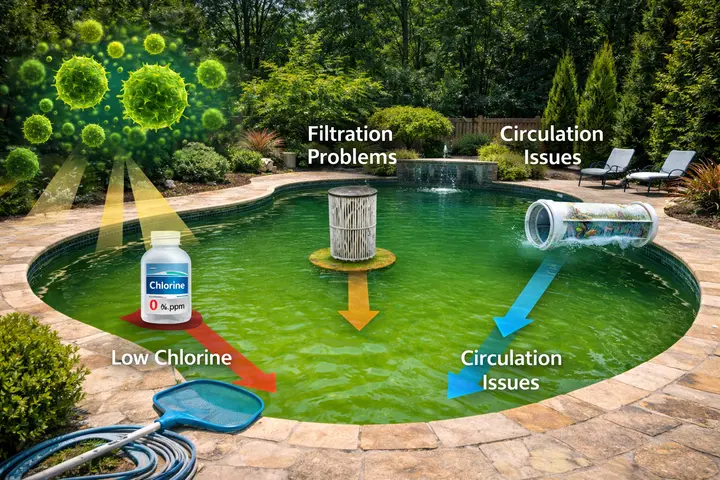
The green tint you see is almost always caused by green algae, a microscopic organism that blooms when pool sanitizer is low, filtration is weak, or circulation is poor. Algae spores are unavoidable– they ride on wind, rain, landscaping runoff, and even your favorite pool float. The issue isn’t that algae exists– it’s the opportunities algae gets to procreate.
The answer to the question, “Why is my pool green?” – Several conditions make algal blooms more likely:
Chlorine levels that dip too low are the most common culprit. Chlorine works as your pool’s primary sanitizer, oxidizer, and algae suppressor. When chlorine drops below 2 ppm, algae reproduce rapidly. Sunlight accelerates the process by continuously degrading free chlorine, which is why a stabilizer (cyanuric acid, or CYA) is crucial in Texas, where UV exposure is relentless.
Filtration problems also play a starring role. Filters that are dirty or overdue for cleaning can’t trap organic contaminants efficiently. That debris– dust, oils, pollen, and plant material– acts as fertilizer for algae. Combine nutrients with warm stagnant water, and you’ve got a recipe for green water.
Circulation issues add to the challenge. Even when chlorine is present, it can’t work in areas the water never reaches. Corners, steps, ladders, and shaded zones can become low-flow hotspots where algae grow undisturbed.
Other common triggers include high pH levels, insufficient pump runtime, clogged skimmers, or sand filters that need fresh media. Heavy rain, wind, or debris storms can dilute sanitizer and introduce fresh spores, making blooms more aggressive.
If you’ve tried every trick to fix the problem fast and it still keeps coming back, you might find yourself asking, “Why does my pool keep turning green?” The honest answer is almost always consistency– your pool wants stability, not sporadic care.
Top Causes We See Across San Antonio
Green water usually boils down to a few repeat offenders:
- Low chlorine or high chlorine demand
- Sunlight burns chlorine faster than it’s replenished
- Pump not running long enough
- Dirty or clogged filter cartridges
- Sand filter media that has aged out
- Poor circulation patterns
- Debris overload after storms or landscaping
- pH drifting out of range
These causes are common throughout South Texas neighborhoods and surrounding areas, and while they’re frustrating, they’re also highly predictable– and solvable.
The Step-by-Step Guide to Cleaning a Green Pool
The Realistic Multi-Day Reset
Day 1 is all about testing, brushing, shocking, and starting filtration. Testing the water gives you a baseline on chlorine, pH, alkalinity, and stabilizer (CYA). Brushing surfaces breaks the biofilm that protects algae colonies. Shocking raises chlorine to algae-kill levels. The filter should run continuously to start removing dead algae and debris.
Days 2 and 3 focus on cleaning or backwashing the filter, brushing again, and keeping chlorine elevated. This is when clarifiers or flocculants can help, depending on pool condition. Debris often settles, requiring another vacuum pass.
By Day 4 or 5, most pools shift from green to cloudy blue/gray– a sign algae are dying and the filtration is working. Chlorine levels should still be monitored and filters cleaned daily if pressure rises.
By Day 6 or 7, water clarity returns, and chemistry can normalize. Only then should the pump return to a regular daily runtime schedule, usually 8-12 hours per day in warmer months.
What Doesn’t Work
If you’re searching for how to clear a green pool overnight, let’s be clear: anything promising true overnight recovery is either misleading or unsafe for equipment and swimmers. The only legitimate version of overnight clearing is killing algae fast– clarity still takes time because dead algae must be filtered out, not wished away.
Draining the pool isn’t usually the answer unless algae have fully coated surfaces or chemistry is severely unstable. Over-shocking repeatedly without filter maintenance can worsen water balance, spike pH, or stress equipment.
Algaecide alone won’t clear a bloom– it’s a support chemical, not the lead character. Circulation fixed without a sanitizer doesn’t kill algae; they just relocate it.
The Professional Advantage
Maximum Pools brings a consistent, process-driven approach to green pool recovery. We know chemical precision matters, but discipline matters even more. Professional cleanup advantages include fast algae killing, commercial-grade vacuums, circulation audits, filter evaluation, and dosing that protects equipment instead of stressing it.
How to Shock a Pool That Is Green (Without Damaging It)
If you’re researching how to shock a pool that is green, here’s the pro-level breakdown in plain language:
- Balance pH first– chlorine is dramatically more effective in
- properly balanced water
- Brush pool surfaces to expose algae to sanitizer
- Raise chlorine to algae-kill levels based on pool volume and
- bloom severity
- Run the pump and filter continuously
- Clean or backwash the filter as pressure increases
- Vacuum debris as it settles
The goal of shock is killing algae fast, not clearing water instantly– adequate filtration is the only thing that can finish the job.
The 3-Step Philosophy for Fixing a Green Pool
Still wondering how to fix a green pool? There are endless chemicals, but only three real requirements to fix green water:
- Sanitizer (chlorine almost always)
- Circulation (pump runtime and waterflow)
- Filtration (clean, functioning, evaluated, maintained)
If any one of these fails, algae wins. If all three are executed consistently, algae lose. It’s simple science informed by a consistent process.
When to Call a Professional
DIY is fine when water is lightly tinted, equipment is working well, and surfaces aren’t slimy. However, you need to call Maximum Pools when water is opaque green, algae coat surfaces, chlorine won’t hold, filter pressure spikes constantly, circulation seems weak, or you want faster, safer recovery.
Maximum Pools’ pool cleaning service is honest and professional because our customers’ trust matters more than chemistry gimmicks or short-term tricks. Stuck asking, “How to fix a green pool?” It’s time to give Maximum Pools a call.
Prevention: How to Get Rid of Green Algae in a Pool and Keep It Gone
Chlorine must be tested regularly, stabilizer must be maintained at Texas-friendly levels, and filters must be cleaned on a schedule. Debris has to be skimmed quickly, pumps run daily, and circulation patterns checked seasonally.
Additionally, sand filters require media replacement every 3-5 years; cartridge filters require monthly maintenance; DE filters require backwashing; and pumps require consistent runtime to operate at full capacity.
If you ever catch yourself searching for how to clean a green pool again, remember: cleanup is chemistry; prevention is discipline.
Call Maximum Pools to Eliminate Algae in Your Pool ASAP
Maximum Pools brings the tools, the chemistry, and the process discipline to restore your water safely and keep it algae-free for good.
Schedule your professional pool consultation to find out how to clean a green pool and keep it clean. Contact us now to schedule the pool maintenance you need to ensure your pool looks pristine, even in Texas weather. Call Maximum Pools today!